
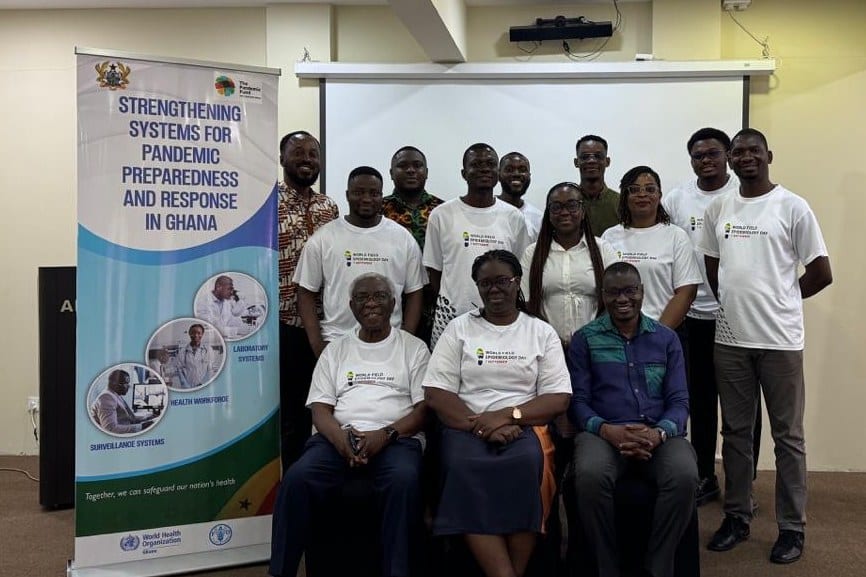
The University of Ghana School of Public Health (UGSPH) in collaboration with AFENET convened 20 participants at AH Hotel, East Legon, Accra, from 7 to 11 September 2026 to develop training materials on advanced spatial epidemiology and artificial intelligence (AI)-assisted predictive modelling.
In his opening remarks, Prof. Ernest Kenu, head of the Department of Epidemiology and Disease Control at the University of Ghana School of Public Health, urged the team to show how fragmented data can affect analysis and prediction. He also asked them to consider whether officers could access and afford the tools after training.
The team drafted eight modules, a capstone project, lesson plans, a training manual, facilitator guides and slides. The course moves from preparing and exploring geographic data in R to building spatial models, interpreting predictions and explaining results to public health teams, so that officers can identify areas of elevated risk and use modelling results in preparedness and response decisions.
Participants also produced guided notebooks, example datasets and case studies that take learners through an analysis from data preparation to interpretation. The capstone centres on a public health problem that draws on skills from several modules. Groups reviewed each other's drafts and agreed a schedule that sequences the technical sessions and hands-on work.
The draft package was validated on 29 and 30 September 2026. This activity was funded by the Pandemic Fund through the World Health Organization.